


Great Salt Lake levels remain low, yet salinity remains close to healthy targets
Author: Brian Maffly
Maffly, Brian. "Great Salt Lake levels remain low, yet salinity remains close to healthy targets" University of Utah News 9 Jan. 2026. https://attheu.utah.edu/research/great-salt-lake-levels-remain-low-yet-salinity-remains-close-to-healthy-targets/ Accessed 16 Feb. 2026.
0 General Document comments
0 Sentence and Paragraph comments
0 Image and Video comments
Great Salt Lake levels remain low, yet salinity remains close to healthy targets
Around the globe, saline terminal lakes, like Utah’s Great Salt Lake, are drying up from diversions that prevent water from reaching these ecologically precious bodies of water.
Utah officials remain confident, however, their Capitol City’s namesake lake will become the world’s first to be restored to health, and that can be accomplished by 2034, when Salt Lake City’s hosts the Winter Olympics.
 “While conditions have stabilized, this report clearly shows that the journey to recovery requires sustained commitment, innovative solutions, and data-driven decisions to secure a healthy future for this vital ecosystem,” Great Salt Lake Commissioner Brian Steed said.
Steed led a newsmakers breakfast Wednesday at the Thomas Monson Center where the Kem C. Gardner Policy Institute released the latest update from Utah’s Great Salt Lake Strike Team.
The annual report, issued in the lead up to the 2026 Legislative Session, details the progress made over the past year to stabilize the Great Salt Lake as well as the challenges that keep the lake ecology below target levels.
“While conditions have stabilized, this report clearly shows that the journey to recovery requires sustained commitment, innovative solutions, and data-driven decisions to secure a healthy future for this vital ecosystem,” Great Salt Lake Commissioner Brian Steed said.
Steed led a newsmakers breakfast Wednesday at the Thomas Monson Center where the Kem C. Gardner Policy Institute released the latest update from Utah’s Great Salt Lake Strike Team.
The annual report, issued in the lead up to the 2026 Legislative Session, details the progress made over the past year to stabilize the Great Salt Lake as well as the challenges that keep the lake ecology below target levels.
“Our report provides a critical understanding of how changes in climate and land use influence the hydrology of the Great Salt Lake watershed,” said team member Paul Brooks, professor of geology & geophysics at the University of Utah. “The collaboration between universities and state agencies, combined with both historical and new government investments in monitoring, has resulted in a dataset on hydrology and water supply unparalleled anywhere in the world. These data and analyses underscore the urgency of implementing comprehensive strategies that account for both natural variability and long-term trends in water supply.”
The report emphasized four critical points:
Water contributions – Between 2021 and 2025, nearly 400,000 acre-feet of water were dedicated and delivered to Great Salt Lake, an achievement made possible by an expanded toolbox of strategies, including water leasing and conservation programs and large-scale phragmites removal projects. Additionally an assessment of the Newfoundland Evaporation Basin shows potential for a modest but reliable 20,000 to 50,000 acre-feet of water annually.
Dust mitigation advances – Efforts to contain dust emissions from exposed lakebed continued with the expansion of the Utah Dust Observation and Research Network (UDORN). The network enhances monitoring capacity to identify dust sources, measuring their composition, and assess potential public health risks.
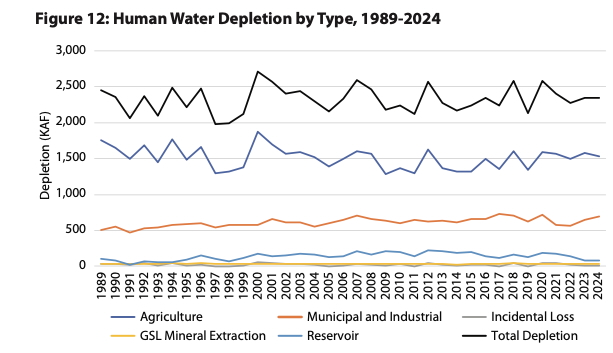
Updated water budget – Revised estimates reveal that municipal and industrial (M&I) depletions account for about a quarter of human-caused depletions, an increase from previous estimates. This updated data emphasizes that all sectors—urban, agricultural, and industrial—must contribute to conservation efforts.
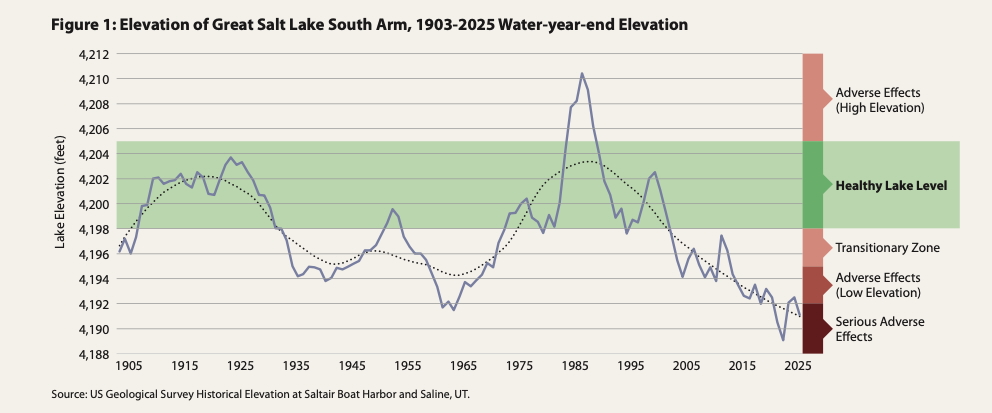
Long-term outlook – While progress continues, the lake’s South Arm finished the 2025 water year at 4,191.1 feet above sea level, the third-lowest recorded elevation since 1903, placing it within the “serious adverse effects” range. Thirty-year projections indicate that a sustained additional inflow of 800,000 acre-feet per year is necessary to return the lake to healthy levels (4,198 feet) by 2055.
“We expect the lake to recover more quickly and get back to those safer positions, the more water we’re able to put in this lake,” said Steed, who is executive director of Utah State University’s Janet Quinney Lawson Institute for Land, Water & Air. “So if there’s a take home message that we can all take to heart it is that yes, humans do have an impact on this lake and, yes, our choices do matter and those choices can actually speed of recovery based on how fast we get more water in the lake.”
A new take on agriculture’s role
 With low water comes elevated salinity, but this past year has seen reductions to more healthy levels thanks to a salinity management system operating on the causeway breach where the lake’s North and South arms meet.
While North Arm salinity remains chronically at saturation point, levels on the South Arm fluctuate from season to season, and year to year.
Despite low water, salinity has been kept within or near the spring target level of 9 to 12%, down from a peak of 18% recorded in 2022, when the lake hit its historic low, according to the report.
With low water comes elevated salinity, but this past year has seen reductions to more healthy levels thanks to a salinity management system operating on the causeway breach where the lake’s North and South arms meet.
While North Arm salinity remains chronically at saturation point, levels on the South Arm fluctuate from season to season, and year to year.
Despite low water, salinity has been kept within or near the spring target level of 9 to 12%, down from a peak of 18% recorded in 2022, when the lake hit its historic low, according to the report.
Perhaps the report’s biggest takeaway is that agriculture’s negative impact on lake levels is not as proportionally severe as previously believed. Under calculations made under an improved measuring system, agriculture’s share of human-caused depletions dropped from 74 to 65% in the Great Salt Lake basin, while it rose from 16 to 23% for municipal and industrial uses. The change demonstrations that urban outdoor water use has historically been underestimated. In other words, green lawns and gardens play a larger role in the lake’s challenges than previously appreciated.
Utah is getting a better handle on its dust problem
Of pressing concern is the 800 square miles of lakebed now exposed to wind erosion that could become a major source of dust pollution for the 2.5 million people living along the Wasatch Front. Dust was a key concern in last year’s strike team report. This year, progress is anticipated in the development of a much needed statewide dust monitoring network focussed largely on populated areas downwind of the lake.

State environmental officials are now installing monitors for large particulate matter, or PM10, in Davis and Weber counties.
“We’ll have more than 10 new monitors in place and there will be additional instrumentation upgrades to some of the existing sites as well. This is super exciting,” said team member Kevin Perry, a U professor of atmospheric sciences and leading expert on playa dust. “There are two types of monitors that are going to be deployed. One is where you see the trend line going up and down. That’s the real time monitors that will give us what’s out there right now, what has it been over the last hour, 24 hours.”
And about two-thirds of the monitoring sites will feature filters that capture the actual dust particles. Lakebed sediments are known to hold heavy metals, but it is not known whether these toxic substances are getting blown into Utah communities.
“You can then monitor the composition of the dust so that you can look and see how many of those metals we’ve identified being out on the lake that arsenic and other carcinogens, how many of those and how often are these being transported to the surrounding communities,” Perry said. “We will be able to answer in a few years the dust frequency and severity, including trends for the very first time. People have been asking me for five years, “Is the dust getting worse?” We don’t have the data for that, but we will moving forward.”
The full report is available from the Gardner Policy Institute.
MEDIA & PR CONTACTS
-
Nick Thiriot Kem C. Gardner Policy Institute communications director
801-842-9150 nick.thiriot@utah.edu -
Brian Maffly Science writer, University of Utah Communications
801-573-2382 brian.maffly@utah.edu
General Document Comments 0


- You’re working with a news-style web article from the University of Utah site, so MLA will want author, article title, site name, publisher (if different), date, and URL.
- From what you pasted, the likely author is Brian Maffly, and the site is @theU (University of Utah news), but you’ll also want to double-check the exact publication date on the webpage itself.
- Once you confirm those, your MLA 9 entry will follow this pattern: Author Last, First. “Title of the Article.” Name of Website, Publisher (if needed), Day Month Year, URL (no hyperlink formatting, just plain text).
- For example, you might end up with something like: Maffly, Brian. “Great Salt Lake Levels Remain Low, Yet Salinity Remains Close to Healthy Targets.” @theU, University of Utah, Day Mon. 2026, attheu.utah.edu/…[rest of URL].
If you look back at the webpage now, what exact author name and date do you see so you can plug them into that MLA pattern—and do you want to click Continue with AI to walk through those two details together, or go to Create Document to paste the article and build citations there on your own?
- This is already a strong MLA 9 citation with all the key parts: author, title, site, date, URL, and access date.
- Your main choice is whether to treat “University of Utah News” as the website name in italics (which works well) and skip the publisher name since they’re the same.
- If you want to polish, you could remove the comma after News and drop the period after the URL since MLA 9 says to avoid extra punctuation after links.
- So your “good enough for a Works Cited” version would look just like what you have, with tiny style tweaks only if your teacher is very strict.
Now that this citation is in solid, good-enough shape, do you want to click Continue with AI so we can look at how it fits into your in-text citation in your paper, or go to Create Document to keep building the rest of your Works Cited on your own?


 on the uploaded document.
0 archived comments