 Writing·Partners
A workspace for literacy learning
AI-supported learning with peers and teachers in the loop
Writing Partners brings students, classmates, teachers, and AI together to draft, share feedback, annotate, and grow ideas. Specialized AI partners coach without taking over, peers enrich the conversation, and teachers guide as they see the learning unfold.
Three connected practices
Three ways to connect. One shared space.
In Writing Partners, students build ideas through social exchange, discover meaning side by side through social annotating, and bring new thinking to life through social making. Move among all three—add AI partners—and turn writing into a more connected experience.
Explore the Digital Discourse Project, a collaboration between Penn and the National Writing Project that informs these social practices.
Create / Edit
Social Making: Writers make meaning together
Writing Partners helps students produce stronger writing by making the process visible: they discover what they think, revise for real readers, and get support when it can make a difference.
Every draft tells a story. Students track revisions and log reflections.
Feedback with proven roots. Peer and AI response, grounded in National Writing Project theory and practice.
See learning as it happens. Teachers step in when it matters.
Read / Annotate
Social Annotating: Readers make thinking visible
Makes the ordinarily private work of reading observable and shareable. A text becomes a shared space where students respond to the author and to one another — and encounter multiple readings of the same passage.
Make thinking visible. Share responses and see how others interpret the same passage.
Read with the AI Thinking Partner. Shaped by WestEd’s Reading Apprenticeship, it helps students notice and explore their thinking.
Turn reading into writing. Build on annotations, questions, and insights.
Discuss / Chat
Social Exchange: Co-creating knowledge
Chatting with a bot meets threaded discussions—with both classmates and AI partners. Learners work through uncertainty, build on others' ideas, test interpretations, and practice the intellectual habits of a learning community.
Explore your interests. Investigate questions with an internet-connected AI Thinking Partner.
Learn with your peers. Share AI conversations, connect perspectives, and build knowledge together.
Inspired by the Connected Learning Alliance. Writing Partners connects students’ interests, peer collaboration, and academic inquiry:
The connective tissue
The power of connected reading, writing, and discussion
Writing Partners resists a common fragmentation in education technology that continues with AI bots and apps—one tool for reading, another for writing, another for feedback. Here, the practices stay connected.
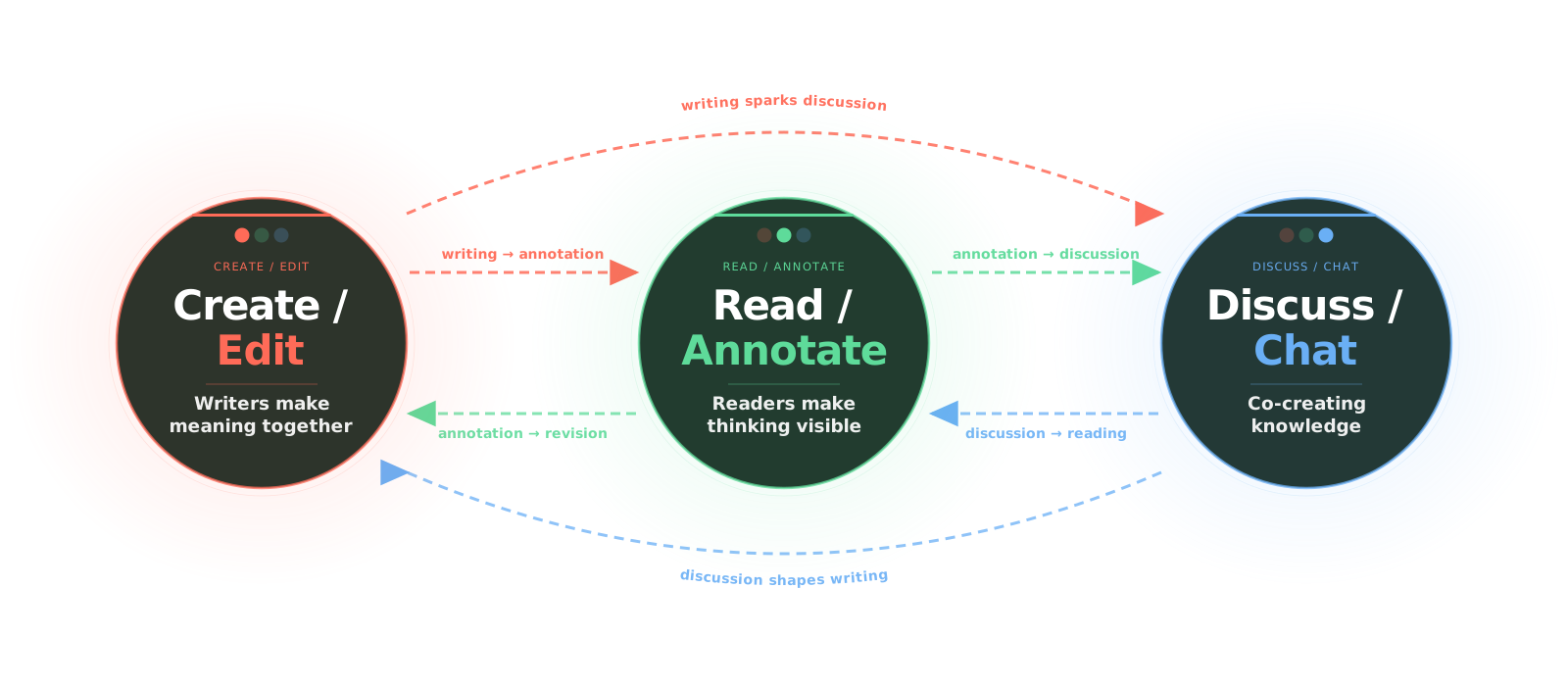
Writing Partners uses AI to support literacy as a social, iterative, and human practice. Students draft and revise ideas, read closely with others, annotate texts, ask questions, exchange feedback, and build knowledge through discussion.
AI designed to support thinking in social learning contexts — not replace it
Writing Partners is not a platform that automates literacy learning. It is a workspace for making literacy learning more visible, social, responsive, and revisable.
AI in Writing Partners acts as a Thinking Partner — posing questions, noticing patterns, offering rehearsal space, suggesting possible next moves. Students remain the authors of their work. Teachers and peers remain essential readers, responders, and guides.
The human community remains responsible for purpose, discernment, care, and meaning. That is a powerful distinction from tools that primarily offer automated scoring, correction, or one-directional feedback.
The result is not less human engagement — it is a shared space where the work of reading, writing, and thinking becomes more visible, collaborative, and open to revision.
The people behind the platform
The platform is the pedagogy
Writing Partners brings AI into the heart of classroom learning—helping students explore ideas, read closely, discuss, and revise without taking over their work. It offers a nudge, a question, a fresh perspective; students remain the authors, and teachers remain in charge.
Student work belongs to students. We don’t sell personal information for advertising or use student content to train AI models. Teachers and authorized school staff can review student activity to support learning and safety.
Unlike a general-purpose chatbot, Writing Partners is built around how learning happens: through student voice, teacher guidance, and peer conversation. No ads, no AI-as-author, no pretending the bot is a person—just a tool designed to help students think more deeply and write with greater purpose.
Our Privacy Policy answers the eight questions to the right, organized around the AI principles that are Common Sense Media's values for AI, which we share.
Questions we help educators pursue
How can teachers and students use AI to keep human judgment at the center of learning? (Put people first)
What can students use AI for that supports learning without doing the work for them? (Be effective)
How might we make AI feedback more responsive to different voices, languages, and writing styles? (Prioritize fairness)
In what ways can we use AI to spark collaboration while keeping conversation and peer feedback alive? (Support human connection)
When information is uncertain, how can we use AI to help us to check claims and think critically about what to trust? (Be trustworthy)
How can we protect student work and personal information when they are using AI? (Keep kids and teens safe)
How can schools keep learning safe and age-appropriate while using AI? (Use data responsibly)
How can we all be clear about when we use AI and make sure people—not AI—make the decisions. (Be transparent and accountable)
Ready to bring Writing Partners to your classroom?
Request access to explore the platform, or get in touch to talk about what a partnership might look like for your school or institution.