WritingPartners
2-Pane Combined
Comments:
Full Summaries Sorted

Voter Turnout in US Elections


0 General Document comments
0 Sentence and Paragraph comments
0 Image and Video comments


1. Voter turnout, 2018-2022

New Writing Partner Conversation New Conversation
Paragraph 1 0
No paragraph-level conversations. Start one.
New Writing Partner Conversation New Conversation
Paragraph 1, Sentence 1 0
No sentence-level conversations. Start one.
New Writing Partner Conversation New Conversation
Paragraph 1, Sentence 2 0
No sentence-level conversations. Start one.

New Writing Partner Conversation New Conversation
Paragraph 2 0
No paragraph-level conversations. Start one.
New Writing Partner Conversation New Conversation
Paragraph 2, Sentence 1 0
No sentence-level conversations. Start one.

New Writing Partner Conversation New Conversation
Paragraph 4 0
No paragraph-level conversations. Start one.
New Writing Partner Conversation New Conversation
Paragraph 4, Sentence 1 0
No sentence-level conversations. Start one.

New Writing Partner Conversation New Conversation
Paragraph 5 0
No paragraph-level conversations. Start one.
New Writing Partner Conversation New Conversation
Paragraph 5, Sentence 1 0
No sentence-level conversations. Start one.

New Writing Partner Conversation New Conversation
Paragraph 6 0
No paragraph-level conversations. Start one.
New Writing Partner Conversation New Conversation
Paragraph 6, Sentence 1 0
No sentence-level conversations. Start one.
New Writing Partner Conversation New Conversation
Paragraph 3 0
No paragraph-level conversations. Start one.
New Writing Partner Conversation New Conversation
Paragraph 3, Sentence 1 0
No sentence-level conversations. Start one.
New Writing Partner Conversation New Conversation
Paragraph 3, Sentence 2 0
No sentence-level conversations. Start one.
New Writing Partner Conversation New Conversation
Paragraph 3, Sentence 3 0
No sentence-level conversations. Start one.
New Writing Partner Conversation New Conversation
Paragraph 3, Sentence 4 0
No sentence-level conversations. Start one.
Terminology
New Writing Partner Conversation New Conversation
Paragraph 7 0
No paragraph-level conversations. Start one.
New Writing Partner Conversation New Conversation
Paragraph 7, Sentence 1 0
No sentence-level conversations. Start one.

The elections of 2018, 2020 and 2022 were three of the highest-turnout U.S. elections of their respective types in decades. About two-thirds (66%) of the voting-eligible population turned out for the 2020 presidential election – the highest rate for any national election since 1900. The 2018 election (49% turnout) had the highest rate for a midterm since 1914. Even the 2022 election’s turnout, with a slightly lower rate of 46%, exceeded that of all midterm elections since 1970.
New Writing Partner Conversation New Conversation
Paragraph 8 0
No paragraph-level conversations. Start one.
New Writing Partner Conversation New Conversation
Paragraph 8, Sentence 1 0
No sentence-level conversations. Start one.
New Writing Partner Conversation New Conversation
Paragraph 8, Sentence 2 0
No sentence-level conversations. Start one.
New Writing Partner Conversation New Conversation
Paragraph 8, Sentence 3 0
No sentence-level conversations. Start one.
New Writing Partner Conversation New Conversation
Paragraph 8, Sentence 4 0
No sentence-level conversations. Start one.

Chart shows most Americans are not consistent voters
New Writing Partner Conversation New Conversation
Paragraph 9 (Image 1) 0
No whole image conversations. Start one.
New Writing Partner Conversation New Conversation
Whole Image 0
No whole image conversations. Start one.

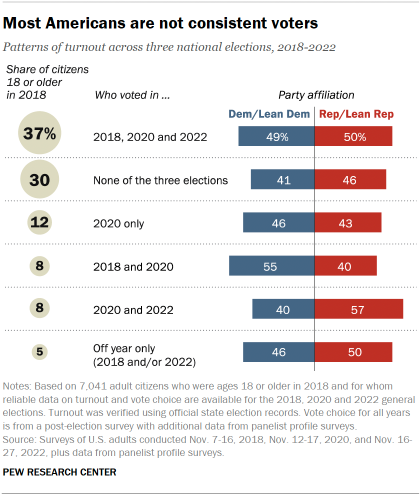
While sizable shares of the public vote either consistently or not at all, many people vote intermittently. Given how closely divided the U.S. is politically, these intermittent voters often determine the outcome of elections and how the balance of support for the two major political parties swings between elections.

New Writing Partner Conversation New Conversation
Paragraph 10 0
No paragraph-level conversations. Start one.
New Writing Partner Conversation New Conversation
Paragraph 10, Sentence 1 0
No sentence-level conversations. Start one.
New Writing Partner Conversation New Conversation
Paragraph 10, Sentence 2 0
No sentence-level conversations. Start one.

Overall, 70% of U.S. adult citizens who were eligible to participate in all three elections between 2018 and 2022 voted in at least one of them, with about half that share (37%) voting in all three.

New Writing Partner Conversation New Conversation
Paragraph 11 0
No paragraph-level conversations. Start one.
New Writing Partner Conversation New Conversation
Paragraph 11, Sentence 1 0
No sentence-level conversations. Start one.

Adults who voted in at least one election during the period divide evenly between Democrats and independents who lean toward the Democratic Party or Republicans and Republican-leaning independents in their current party affiliation (48% each). The subset who voted in all three elections are similarly divided (49% Democrats, 50% Republicans). Citizens who did not vote in any of the three tilt Republican by 46% to 41%.

New Writing Partner Conversation New Conversation
Paragraph 12 0
No paragraph-level conversations. Start one.
New Writing Partner Conversation New Conversation
Paragraph 12, Sentence 1 0
No sentence-level conversations. Start one.
New Writing Partner Conversation New Conversation
Paragraph 12, Sentence 2 0
No sentence-level conversations. Start one.
New Writing Partner Conversation New Conversation
Paragraph 12, Sentence 3 0
No sentence-level conversations. Start one.

Democrats outnumbered Republicans among the 8% of adult citizens who voted in 2018 and 2020 but not 2022 (55% Democratic, 40% Republican). A similar-sized group (8%) voted in 2020 and 2022 but not 2018, and this group’s composition tilts Republican (57%, vs. 40% Democratic). The 12% who voted in 2020 and opted out of both the 2018 and 2022 midterms were roughly evenly divided among Democrats (46%) and Republicans (43%).

New Writing Partner Conversation New Conversation
Paragraph 13 0
No paragraph-level conversations. Start one.
New Writing Partner Conversation New Conversation
Paragraph 13, Sentence 1 0
No sentence-level conversations. Start one.
New Writing Partner Conversation New Conversation
Paragraph 13, Sentence 2 0
No sentence-level conversations. Start one.
New Writing Partner Conversation New Conversation
Paragraph 13, Sentence 3 0
No sentence-level conversations. Start one.

Given the sizable number of intermittent voters and chronic nonvoters, as well as the fact that this group, collectively, is fairly evenly divided in partisan affiliation, both parties have plenty of potential supporters on the sidelines in any given election.

New Writing Partner Conversation New Conversation
Paragraph 14 0
No paragraph-level conversations. Start one.
New Writing Partner Conversation New Conversation
Paragraph 14, Sentence 1 0
No sentence-level conversations. Start one.

Political preferences differ a lot by race and ethnicity … and so does voter turnout
New Writing Partner Conversation New Conversation
Paragraph 15 0
No paragraph-level conversations. Start one.
New Writing Partner Conversation New Conversation
Paragraph 15, Sentence 1 0
No sentence-level conversations. Start one.

Chart shows the racial and ethnic divide in 2022 vote choice for U.S. House
New Writing Partner Conversation New Conversation
Paragraph 16 (Image 2) 0
No whole image conversations. Start one.
New Writing Partner Conversation New Conversation
Whole Image 0
No whole image conversations. Start one.

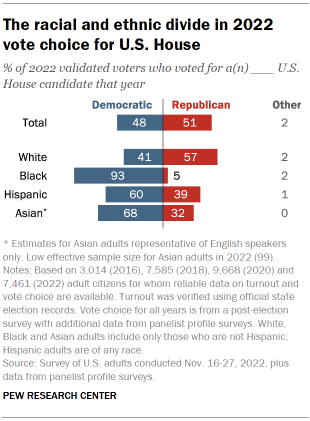
Race and ethnicity are fundamental dividing lines in American politics, with political preferences and electoral participation varying greatly by race and ethnicity.

New Writing Partner Conversation New Conversation
Paragraph 17 0
No paragraph-level conversations. Start one.
New Writing Partner Conversation New Conversation
Paragraph 17, Sentence 1 0
No sentence-level conversations. Start one.

In the current partisan alignment, Black, Hispanic and Asian voters are all majority Democratic groups, to different degrees, though Republican candidates have gained some ground in the past four years among Hispanic voters.

New Writing Partner Conversation New Conversation
Paragraph 18 0
No paragraph-level conversations. Start one.
New Writing Partner Conversation New Conversation
Paragraph 18, Sentence 1 0
No sentence-level conversations. Start one.

Black voters remain Democratic stalwarts, voting 93% to 5% for the party’s candidates for U.S. House in 2022. Hispanic and Asian voters clearly favored Democratic candidates as well, but by narrower margins: 60% to 39% for Hispanic voters, and 68% to 32% for Asian voters.

New Writing Partner Conversation New Conversation
Paragraph 19 0
No paragraph-level conversations. Start one.
New Writing Partner Conversation New Conversation
Paragraph 19, Sentence 1 0
No sentence-level conversations. Start one.
New Writing Partner Conversation New Conversation
Paragraph 19, Sentence 2 0
No sentence-level conversations. Start one.

Chart shows White adults voted more consistently than those of other racial or ethnic backgrounds from 2018 through 2022
New Writing Partner Conversation New Conversation
Paragraph 20 (Image 3) 0
No whole image conversations. Start one.
New Writing Partner Conversation New Conversation
Whole Image 0
No whole image conversations. Start one.

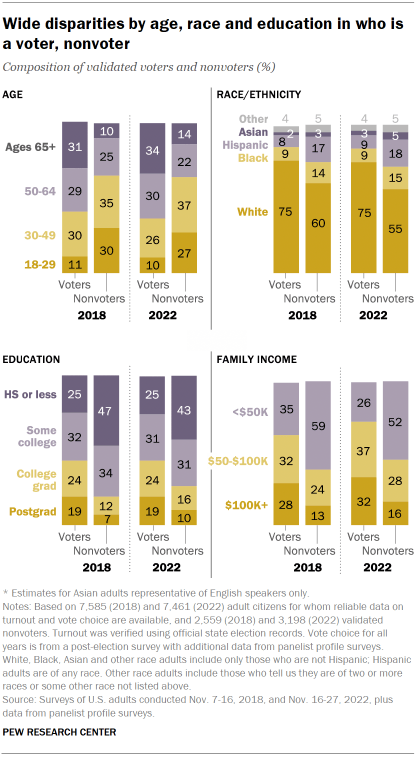
But White Americans are much more consistent voters than Black, Hispanic or Asian Americans. Compared with the national average of 37% who voted in 2018, 2020 and 2022, 43% of White citizens who were age eligible to vote in all three elections did so; just 24% did not vote in any of these.

New Writing Partner Conversation New Conversation
Paragraph 21 0
No paragraph-level conversations. Start one.
New Writing Partner Conversation New Conversation
Paragraph 21, Sentence 1 0
No sentence-level conversations. Start one.
New Writing Partner Conversation New Conversation
Paragraph 21, Sentence 2 0
No sentence-level conversations. Start one.

Black, Hispanic and Asian adults lagged far behind, with 27% of Black, 19% of Hispanic and 21% of Asian age-eligible citizens voting in all three elections. Hispanic citizens were most likely to have not voted in any of the most recent three general elections (47%, compared with 36% for Black and 31% for Asian citizens ages 22 and older in 2022).

New Writing Partner Conversation New Conversation
Paragraph 22 0
No paragraph-level conversations. Start one.
New Writing Partner Conversation New Conversation
Paragraph 22, Sentence 1 0
No sentence-level conversations. Start one.
New Writing Partner Conversation New Conversation
Paragraph 22, Sentence 2 0
No sentence-level conversations. Start one.

Differences by education

New Writing Partner Conversation New Conversation
Paragraph 23 0
No paragraph-level conversations. Start one.
New Writing Partner Conversation New Conversation
Paragraph 23, Sentence 1 0
No sentence-level conversations. Start one.

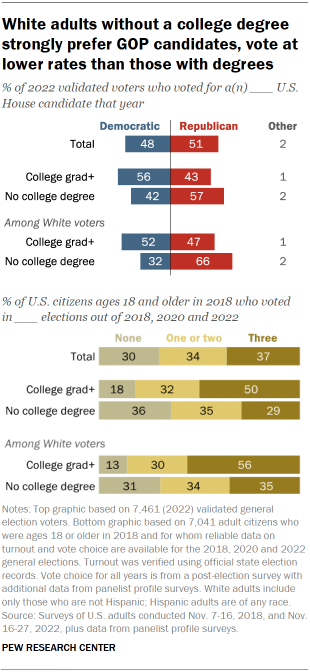
Over the past few election cycles, Republicans have gained ground among White adults who do not have a college degree, who make up 41% of eligible voters. This group is about average in its consistency of voter turnout, with 35% of those ages 22 and over in 2022 voting in 2018, 2020 and 2022, and 31% voting in none of these three elections. White voters without a college degree favored Republican House candidates 66% to 32% in 2022.

New Writing Partner Conversation New Conversation
Paragraph 24 0
No paragraph-level conversations. Start one.
New Writing Partner Conversation New Conversation
Paragraph 24, Sentence 1 0
No sentence-level conversations. Start one.
New Writing Partner Conversation New Conversation
Paragraph 24, Sentence 2 0
No sentence-level conversations. Start one.
New Writing Partner Conversation New Conversation
Paragraph 24, Sentence 3 0
No sentence-level conversations. Start one.

By contrast, White adults with college degrees vote at very high rates: 56% of those eligible turned out in all three elections and just 13% participated in none of them. College-educated White adults make up 24% of the eligible electorate but about a third of voters in 2022 (34%). White voters with college degrees had tilted Republican for several decades, but in the past four elections have favored Democratic candidates (52% to 47% in 2022).
New Writing Partner Conversation New Conversation
Paragraph 25 0
No paragraph-level conversations. Start one.
New Writing Partner Conversation New Conversation
Paragraph 25, Sentence 1 0
No sentence-level conversations. Start one.
New Writing Partner Conversation New Conversation
Paragraph 25, Sentence 2 0
No sentence-level conversations. Start one.
New Writing Partner Conversation New Conversation
Paragraph 25, Sentence 3 0
No sentence-level conversations. Start one.

Chart shows White adults without a college degree
strongly prefer GOP candidates, vote at
lower rates than those with degrees
New Writing Partner Conversation New Conversation
Paragraph 26 (Image 4) 0
No whole image conversations. Start one.
New Writing Partner Conversation New Conversation
Whole Image 0
No whole image conversations. Start one.

The education gap in White voters’ preferences in 2022 was not apparent among either Black or Hispanic voters (the sample size of Asian voters without a college degree was too small to produce a reliable estimate). College-educated Black and Hispanic adults also voted at higher rates than Black and Hispanic adults without a college degree in each of the three elections.

New Writing Partner Conversation New Conversation
Paragraph 27 0
No paragraph-level conversations. Start one.
New Writing Partner Conversation New Conversation
Paragraph 27, Sentence 1 0
No sentence-level conversations. Start one.
New Writing Partner Conversation New Conversation
Paragraph 27, Sentence 2 0
No sentence-level conversations. Start one.

A small education gap appeared in 2020 presidential preference among Hispanic voters: College-educated Hispanic voters preferred Biden by a margin of 69% to 29%, while Hispanic voters without a college degree preferred Biden by a somewhat narrower margin (58% to 39%). But no significant education gap in candidate preference was observed for Black or Hispanic voters in 2018 or 2022, nor for Black voters in 2020.

New Writing Partner Conversation New Conversation
Paragraph 28 0
No paragraph-level conversations. Start one.
New Writing Partner Conversation New Conversation
Paragraph 28, Sentence 1 0
No sentence-level conversations. Start one.
New Writing Partner Conversation New Conversation
Paragraph 28, Sentence 2 0
No sentence-level conversations. Start one.

The upshot of racial differences in candidate preference and turnout patterns is that Republican candidates benefited from both the relatively large size of the White adult population without a college degree and their somewhat higher turnout rates compared with Black, Hispanic and Asian adults.

New Writing Partner Conversation New Conversation
Paragraph 29 0
No paragraph-level conversations. Start one.
New Writing Partner Conversation New Conversation
Paragraph 29, Sentence 1 0
No sentence-level conversations. Start one.

Growth in support for Democratic candidates among White voters with a college degree, along with the high turnout levels among this group, offset some of the growth in support for the Republican Party among White voters without a college degree. But college-educated White adults remain a smaller share of all eligible voters than White adults without a college degree.

New Writing Partner Conversation New Conversation
Paragraph 30 0
No paragraph-level conversations. Start one.
New Writing Partner Conversation New Conversation
Paragraph 30, Sentence 1 0
No sentence-level conversations. Start one.
New Writing Partner Conversation New Conversation
Paragraph 30, Sentence 2 0
No sentence-level conversations. Start one.

Voters and nonvoters

New Writing Partner Conversation New Conversation
Paragraph 31 0
No paragraph-level conversations. Start one.
New Writing Partner Conversation New Conversation
Paragraph 31, Sentence 1 0
No sentence-level conversations. Start one.

Chart shows wide disparities by age, race and education in who is a voter, nonvoter
New Writing Partner Conversation New Conversation
Paragraph 32 (Image 5) 0
No whole image conversations. Start one.
New Writing Partner Conversation New Conversation
Whole Image 0
No whole image conversations. Start one.

The two most recent midterms – 2022 and 2018 – both featured unusually high turnout compared with nearly every other recent midterm election year. But the differences between those who turned out to vote in 2022 versus 2018 – and between those who did not vote – accounted for much of the difference in outcomes between the two elections.

New Writing Partner Conversation New Conversation
Paragraph 33 0
No paragraph-level conversations. Start one.
New Writing Partner Conversation New Conversation
Paragraph 33, Sentence 1 0
No sentence-level conversations. Start one.
New Writing Partner Conversation New Conversation
Paragraph 33, Sentence 2 0
No sentence-level conversations. Start one.

The stark demographic differences between voters and nonvoters in 2022 are similar to those seen in previous U.S. elections.

New Writing Partner Conversation New Conversation
Paragraph 34 0
No paragraph-level conversations. Start one.
New Writing Partner Conversation New Conversation
Paragraph 34, Sentence 1 0
No sentence-level conversations. Start one.

Voters were much older, on average, than nonvoters. Adults under 50 made up 36% of voters, but 64% of nonvoters. This is very similar to the pattern seen in 2018 – although those under 50 made up a somewhat larger share of voters in 2018 (40%).

New Writing Partner Conversation New Conversation
Paragraph 35 0
No paragraph-level conversations. Start one.
New Writing Partner Conversation New Conversation
Paragraph 35, Sentence 1 0
No sentence-level conversations. Start one.
New Writing Partner Conversation New Conversation
Paragraph 35, Sentence 2 0
No sentence-level conversations. Start one.
New Writing Partner Conversation New Conversation
Paragraph 35, Sentence 3 0
No sentence-level conversations. Start one.

Turnout also differed by race and ethnicity.

New Writing Partner Conversation New Conversation
Paragraph 36 0
No paragraph-level conversations. Start one.
New Writing Partner Conversation New Conversation
Paragraph 36, Sentence 1 0
No sentence-level conversations. Start one.

Three-quarters of voters (75%) were White, non-Hispanic adults. But this group accounted for a smaller share (55%) of nonvoters. Hispanic adults and Black, non-Hispanic adults each made up 9% of voters, but slightly larger shares of nonvoters (18% and 15%, respectively). Asian Americans made up 3% of voters, and a slightly higher share (5%) of nonvoters. These differences are nearly identical to the patterns seen in 2018.

New Writing Partner Conversation New Conversation
Paragraph 37 0
No paragraph-level conversations. Start one.
New Writing Partner Conversation New Conversation
Paragraph 37, Sentence 1 0
No sentence-level conversations. Start one.
New Writing Partner Conversation New Conversation
Paragraph 37, Sentence 2 0
No sentence-level conversations. Start one.
New Writing Partner Conversation New Conversation
Paragraph 37, Sentence 3 0
No sentence-level conversations. Start one.
New Writing Partner Conversation New Conversation
Paragraph 37, Sentence 4 0
No sentence-level conversations. Start one.
New Writing Partner Conversation New Conversation
Paragraph 37, Sentence 5 0
No sentence-level conversations. Start one.

There are also large educational and income differences between voters and nonvoters. Adults with a college degree made up 43% of voters in 2022, but only 25% of nonvoters. Those without a college degree made up 56% of voters, but 74% of nonvoters.

New Writing Partner Conversation New Conversation
Paragraph 38 0
No paragraph-level conversations. Start one.
New Writing Partner Conversation New Conversation
Paragraph 38, Sentence 1 0
No sentence-level conversations. Start one.
New Writing Partner Conversation New Conversation
Paragraph 38, Sentence 2 0
No sentence-level conversations. Start one.
New Writing Partner Conversation New Conversation
Paragraph 38, Sentence 3 0
No sentence-level conversations. Start one.

Voting methods in the 2022 election

New Writing Partner Conversation New Conversation
Paragraph 39 0
No paragraph-level conversations. Start one.
New Writing Partner Conversation New Conversation
Paragraph 39, Sentence 1 0
No sentence-level conversations. Start one.

Chart shows smaller shares voted by absentee or mail-in ballot in 2022 than in 2020
New Writing Partner Conversation New Conversation
Paragraph 40 (Image 6) 0
No whole image conversations. Start one.
New Writing Partner Conversation New Conversation
Whole Image 0
No whole image conversations. Start one.

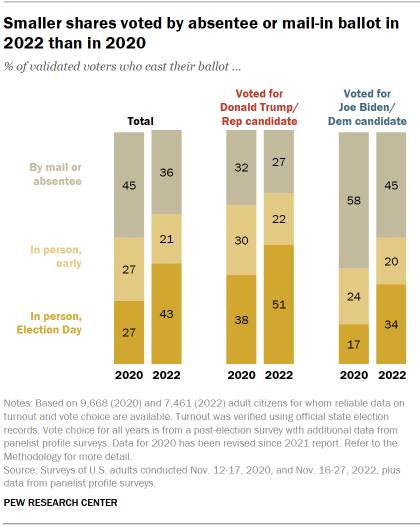
As concerns over the COVID-19 pandemic declined, fewer voters reported having voted absentee or by mail in 2022 than in 2020.

New Writing Partner Conversation New Conversation
Paragraph 41 0
No paragraph-level conversations. Start one.
New Writing Partner Conversation New Conversation
Paragraph 41, Sentence 1 0
No sentence-level conversations. Start one.

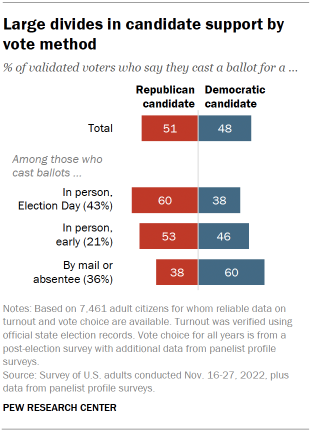
In 2022, 43% of voters said they cast their ballot in person on Election Day. A somewhat smaller share (36%) said they cast an absentee or mail-in ballot, and 21% said they voted in person before Election Day.

New Writing Partner Conversation New Conversation
Paragraph 42 0
No paragraph-level conversations. Start one.
New Writing Partner Conversation New Conversation
Paragraph 42, Sentence 1 0
No sentence-level conversations. Start one.
New Writing Partner Conversation New Conversation
Paragraph 42, Sentence 2 0
No sentence-level conversations. Start one.

In the 2020 election, held during the first year of the coronavirus pandemic, 45% of voters said they cast their ballots by absentee or mail-in ballot, while identical shares (27%) said they voted in person either on Election Day or beforehand.

New Writing Partner Conversation New Conversation
Paragraph 43 0
No paragraph-level conversations. Start one.
New Writing Partner Conversation New Conversation
Paragraph 43, Sentence 1 0
No sentence-level conversations. Start one.

As was the case in 2020, voters who supported Republican candidates were more likely to report having voted in person on Election Day than by other methods. About half (51%) of those who supported Republicans said they voted this way, while smaller shares said they voted by mail or absentee ballot (27%) or voted in person before Election Day (22%). In 2020, 38% said they voted in person on Election Day, while somewhat smaller shares said they voted by mail or absentee (32%) or voted in person before Election Day (30%).
New Writing Partner Conversation New Conversation
Paragraph 44 0
No paragraph-level conversations. Start one.
New Writing Partner Conversation New Conversation
Paragraph 44, Sentence 1 0
No sentence-level conversations. Start one.
New Writing Partner Conversation New Conversation
Paragraph 44, Sentence 2 0
No sentence-level conversations. Start one.
New Writing Partner Conversation New Conversation
Paragraph 44, Sentence 3 0
No sentence-level conversations. Start one.

Chart shows large divides in candidate support by vote method
New Writing Partner Conversation New Conversation
Paragraph 45 (Image 7) 0
No whole image conversations. Start one.
New Writing Partner Conversation New Conversation
Whole Image 0
No whole image conversations. Start one.

Voters who supported Democratic candidates were more likely to say they cast absentee or mail-in ballots (45%). About one-third (34%) said they voted in person on Election Day and two-in-ten said they voted in person before Election Day. In 2020, a 58% majority said they voted by mail or absentee ballot, while just 17% said they voted in person on Election Day.

New Writing Partner Conversation New Conversation
Paragraph 46 0
No paragraph-level conversations. Start one.
New Writing Partner Conversation New Conversation
Paragraph 46, Sentence 1 0
No sentence-level conversations. Start one.
New Writing Partner Conversation New Conversation
Paragraph 46, Sentence 2 0
No sentence-level conversations. Start one.
New Writing Partner Conversation New Conversation
Paragraph 46, Sentence 3 0
No sentence-level conversations. Start one.

Reflecting these patterns, Republicans won a majority of votes among those who said they voted in person on Election Day, 60% to 38%. Democrats won – by an identical margin – voters who said they voted by mail or absentee ballot. Those who said they voted in person before Election Day were divided: 53% supported Republican candidates, while 46% voted for Democratic candidates.

New Writing Partner Conversation New Conversation
Paragraph 47 0
No paragraph-level conversations. Start one.
New Writing Partner Conversation New Conversation
Paragraph 47, Sentence 1 0
No sentence-level conversations. Start one.
New Writing Partner Conversation New Conversation
Paragraph 47, Sentence 2 0
No sentence-level conversations. Start one.
New Writing Partner Conversation New Conversation
Paragraph 47, Sentence 3 0
No sentence-level conversations. Start one.

DMU Timestamp: March 12, 2025 01:37

General Document Comments 0
New Writing Partner Conversation Start a new Document-level conversation

profile_photo
Mar 12
2025 Chance V 2025 Chance V (Mar 12 2025 11:02AM) : See Full Comment more

High Voter Turnout: The 2018, 2020, and 2022 elections saw some of the highest voter participation rates in decades. The 2020 presidential election had a 66% turnout, the highest since 1900, while the 2018 midterm reached 49%, the highest since 1914. The 2022 midterm had a slightly lower turnout (46%) but still exceeded all midterms since 1970.

Intermittent Voters: While some Americans vote consistently, many vote sporadically. About 70% of eligible voters participated in at least one of the three elections, with 37% voting in all three. Intermittent voters often play a decisive role in election outcomes.

Partisan Breakdown: Among those who voted in all three elections, the partisan split was nearly even (49% Democrat, 50% Republican). Nonvoters leaned slightly Republican (46% Republican, 41% Democrat).

Race and Ethnicity: Political preferences and turnout rates varied by race:

Black, Hispanic, and Asian voters leaned Democratic, though Republicans gained some ground among Hispanics.
White Americans had the highest turnout, with 43% voting in all three elections. In contrast, only 27% of Black, 21% of Asian, and 19% of Hispanic eligible voters did so.
Hispanic voters had the highest percentage of nonvoters (47%).
Education and Voting:

White voters without a college degree leaned Republican (66% to 32% in 2022).
White college graduates favored Democrats (52% to 47%).
College-educated voters, across racial groups, had higher turnout rates.
Voter Demographics:

Older voters turned out at much higher rates than younger voters.
White, non-Hispanic adults made up 75% of voters but only 55% of nonvoters.
College graduates accounted for 43% of voters but only 25% of nonvoters.
Voting Methods:

Mail-in voting decreased from 45% in 2020 to 36% in 2022 as COVID-19 concerns declined.
Republicans were more likely to vote in person on Election Day (51%).
Democrats favored mail-in voting (45% in 2022, down from 58% in 2020).
These findings illustrate how voter participation varies by demographics, political affiliation, and voting method, shaping election outcomes.

Image
0 comments, 0 areas
add area
add comment
change display
Video
add comment

How to Start with AI-guided Writing

  • Write a quick preview for your work.
  • Enable AI features & Upload.
  • Click Ask AI on the uploaded document.
    It's on the right side of your screen next to General Document Comments.
  • Select Quickstart Pathfinder & ask how to begin.
  • Click Continue.
  • Click Start Conversation. after the results appear.

Welcome!

Logging in, please wait... Blue_on_grey_spinner