Please wait...


Uploading, Collecting, Copying, and Controlling Access to Documents
Organizing and Sharing Documents
Basic Document Creating
Advanced Document Features
Your Upload Begins!
Copying Documents
- Organizing and Sharing Documents
- Create or Join a group from your Library
- Create a private or public group using the Create Groups button in the right column next to your library. Last names can be hidden in public groups.
OR - Join an already existing private or public group that has been shared with you in your Library. See the public groups on the UN SDGs page.
- Invite students, colleagues, or friends to the group that you just created (and made public or kept private), using the Invite button in the top-left corner of the main menu.
- Create a private or public group using the Create Groups button in the right column next to your library. Last names can be hidden in public groups.
- Create or Add to Group Collections from a Group page
- Create a private or public Group Collection on a Group page using the Create a Group Collection button in the top right corner of any group page.
- Groups are private by default. Any members of a group and anyone you invite to it will be able to add to the collections in that group.
- You can choose to make a collection public. Any Writing Partner user can join a public group and be able to add to the collections in that group.
- You can also add documents you have already created to already existing public collections in any group in which you are a member.
- Invite students, colleagues, or friends to the collecction that you just created (and made public or kept private) or added to, using the Invite button in the top-left corner of the main menu.
- Create a private or public Group Collection on a Group page using the Create a Group Collection button in the top right corner of any group page.
- Create and Add Documents to Group Collections.
- Add a document that you have already created to any public group collection in a group in which you are a member.
OR - Go back to any group in which you are a member, and use the Create Document button, in the middle of the main menu to upload videos, images, or texts that you want in your new group collection. Then add those documents to the group collection you created or that you are adding to. You can also add documents to collections in the options next to each document in your library.
- Documents are private by default and you can make them public. If you add a private document to a public collection, you will be prompted to agree to making your document public when you add it to that public collection. Last names can be hidden on private and public documents.
- Use the Invite button in the left corner of each document (both public or public) to invite others to also join you on those documents.
- Add a document that you have already created to any public group collection in a group in which you are a member.
- Choose the public group where you will make a public group collection. Decide which one of the 17 United Nations Sustainable Development Goals most closely relates to your topic, issue, person, or question. Chat with the Thinking Parther and/or search the Web with a keyword from your topic along with the words “UN Sustainable Development Goals” (SDG) and see where your inquiry or person seems to fit.
- After choosing your SDG, join the study group on Writing Partners for that SDG. Click here to find the 17 study groups for the UN Sustainable Development Goals.
- Click the Create a Group Collection button and create a public collection for the videos, images, and texts that you want to organize together and share with others.Title your Group Collection with an open-ended, researchable inquiry question.
- Add a document that you have already created to the group collection that you just created.
OR - Go back to the Study Group, and click Create Document and upload a video, image, or text that you want in your new group collection. Then add that document to the group collection you created.
- Here are the settings you should use in a document's Properties (which you find under More) when creating a public collection.

- Privacy: Public
- Links: Allow
- Images and videos: Allow
- Last Names: Hide
- Solicit Revisions: No
- Others can append: No
- Enable image commenting: Yes
- Hide replaced paragraphs: Yes
- Enaable AI commenting: Yes
- Include Usage report: Yes
- Check that your title is accurate.

At some point, everything in the Document Information fields should be completed. This doesn't have to be done when you first upload. It can be done later.
- Basic Document Creating
- Microsoft Word or Excel
- Video
- PowerPoint
- Image (various formats, no OCR)
- Web Page (HTML) Content — Text+Images and Video Techniques
- Text I'll Write Now
- Microsoft Word and Excel — .doc, .docx, .rtf, .xls, .xlsx file extensions
- Video Once you have copied the embed code from a YouTube or a Vimeo video paste it into the upload text box. The video will not appear until after you upload the code. You will only see code until you upload.
- PowerPoint
- Image/Photo
- Alt text — short alternative text for those who are visually-impaired or using non-visual web browsers. For example, Alt text for a photo of a stop sign might be "red stop sign" (without quote marks)
- Tooltip — this is text that will pop up when someone who can see the image mouses over it. It can be the same as the Alt text.
- Copy-and-Paste from Web Page (HTML)
- Give your document a Title.
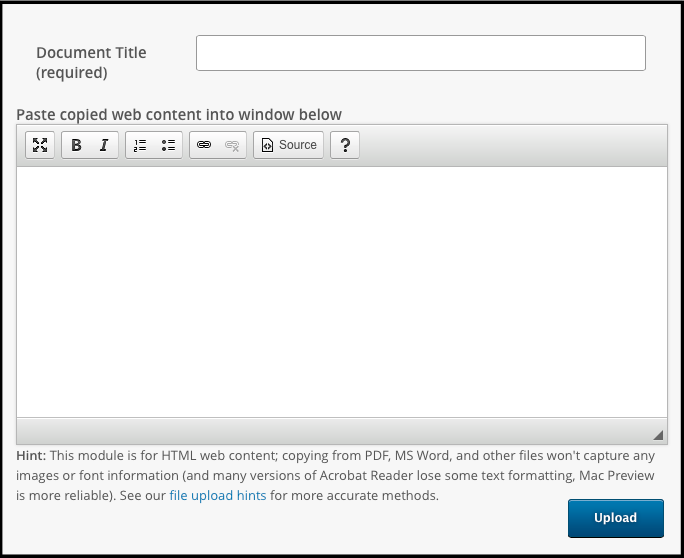
- Copy all the text and images you want in your document from the desired web page(s), then paste what you copied into the big data entry box (under Document Title). You can delete any content not needed for discussion (e.g. irrelevant text and graphics, advertisements, site navigation links, whatever!) from the data entry window to give your readers a clean, customized document.
- You can have content from multiple websites in a single Writing Partners document, either by:
- Copy-and-pasting various text, images, and media player embed codes from various sites into the initial document upload,
- Or later appending new material (e.g. adding a video to an MS Word document)
- Use PrintFriendly (printfriendly.com) to get an ad-free, basic-formatted page that you can copy and paste on Writing Partners.
- Excel, PowerPoint, MS Word, and other documents in proprietary formats, even if online, are not really HTML, and copy-and-pasting their content into an HTML data entry window won't give good results. For file conversion tips see our upload hints page.
- There are editing control buttons at the top of the copy-and-paste window:

The icons (reading left to right) let you:
- Maximize the size of the data entry window (full screen)
- Bold text
- Italicize text
- Format text as a numbered list
- Format text as a bulleted list
- Create a hyperlink
- Remove a hyperlink
- For those comfortable working with HTML, use the “Source” button to view the HTML source… or edit and then upload the document's HTML markup for maximum control over your document's display
- Get additional “Help” information on these controls
- Text I'll Write Now
- Advanced Document Features
- set date/time due (with optional email reminder)
- set Minimum and/or Maximum number of Comments
- don't let others read this document before a date/time I set
- don't let others comment before a date/time I set
- don't let others see comments before a date/time I set
- let anyone on the Internet read this document (a “Public Document”
- email me all comments on this document (“Updates”)
- disallow Revision Suggestions for the document text
- all invited users can append content
- customize meanings of highlight colors
- supply bibliographic document information (metadata)
- show me private replies too — users will be warned [Note: used mainly when an Instructor needs to see private comments between students]
- turn off the Image Commenting toolbar (useful in cases where the page aesthetics are critical and the Writing Partners toolbar would be out-of-place)
- Your Upload Begins!
- An initial page with a few general tips while the document is loading:
- Viewing your document to make sure it came out nicely for discussion purposes (highly recommended). If not, you can edit your document in N if you see typos or other minor mistakes, or append material if your forgot something. If you see major problems with the document (rare) then it's probably better to edit the original document, re-upload it, and them delete this attempt.
- “Invite” people or Group(s) to the document
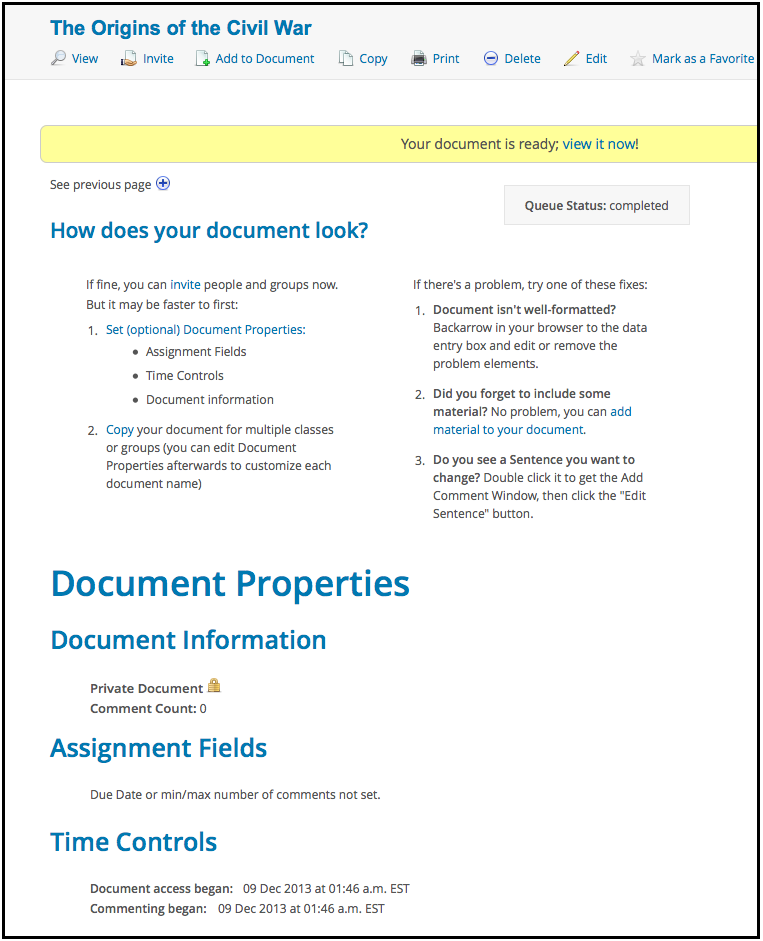
- Once uploaded, a second page showing the possible next steps:
-->
- Copying Documents
- Make Multiple Copies (no copying to Groups)
- Make Multiple Copies and Share them with Groups
See below for how to Create a Public Collection for a Person or an Issue in Literature, Politics, History, Science, Art, Music... on Writing Partners
Create a Public Collection for a Person or an Issue in Literature, Politics, History, Science, Art, Music.. on Writing Partners
To get more help with these directions, chat with the Guide for Creating Public Collections
To make a document available on Writing Partners, click the “Create Document” link at the top of almost every page. This will take you to our Create Document page where you can upload documents from any of five file formats or you can write your own.:
Click the button corresponding to the file type you want to upload to reach the appropriate upload window:

If your file type isn't one of the above (e.g. if it' PDF or LaTeX) then open the application you used to create that file and use its File Menu to do a “Save As” or “Export&rdquo: to convert your document to one of the five formats we accept (or perhaps use a 3rd party converter application). Copy-and-pasting from another format will almost never give good results, e.g. your document may wind up with white space (carriage returns) after every physical line rather than just between paragraphs.
Note these general upload hints and limits:
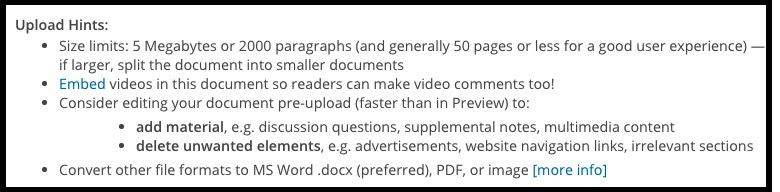
We'll now explain how to upload each format in detail:
A directory window will immediately open so you can select your upload file:
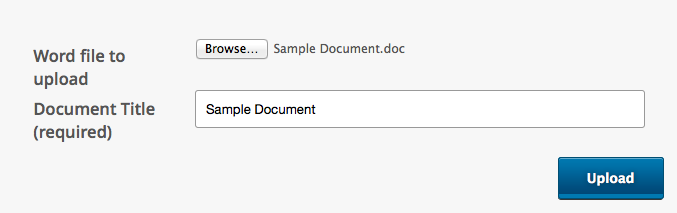
Once selected, you can use the file name as your document title or, more commonly, give the document a more explanatory name (if you change your mind about which file to upload you can choose another file by clicking the small gray “Choose File” button next to the name of the currently selected document).
Now click the blue “Upload” button (toward the bottom right corner of your screen) to upload your document.

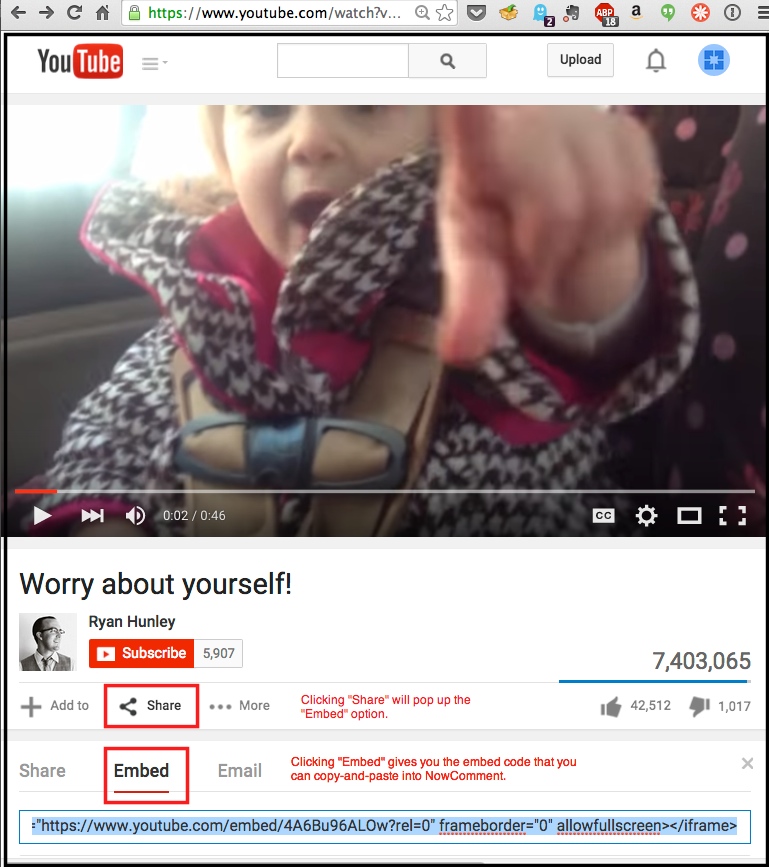
For video and audio players, paste their embed codes (sometimes referred to as “Share” or “Sharing” information) into the Writing Partners data entry box wherever you want that media player to appear in a document. You can also put video embed codes in the Web uploading box.
Again, note that copy-and-pasting the media player itself won't work!
Here's a YouTube example of where to find, and then copy-and-paste, an embed code:
Once you've selected a PowerPoint (.ppt, .pptx) file and specified a document name, Writing Partners will upload each slide as a separate image on a document.

You can upload a document containing only a photo or other image and comment on it with our image toolbar. At any point afterwards you can also append text and/or video and/or another image to the image you've uploaded.
Writing Partners handles JPEG, Png, Gif, Tiff, and SVG formats. We strongly suggest avoiding Tiff because most browsers can't display that format.
Image file uploads work basically the same way as other file types:

except that it is good practice to also provide information for two image-specific fields:
You can now click the blue “Upload” button (toward the bottom right corner of your screen) to upload your image.
Click the blue “Upload” button (toward the bottom right corner of your screen) to upload your document
Hints for Copy-and-Paste Uploads
You can write something on the spot with this option, e.g. a quick note or an idea you'd like some quick feedback on or a complete draft of something you are composing. .You can add images (either selected from your drive or AI generated) as well. Once uploaded this module allows you to edit and format the text and add images the way you would on any word processor. Edits are saved automatically and versions can be viewed by the user or and administrator (teacher) of the user. The text in an editable document is not chunked by sentences and paragraphs the way it is on other documents on Writing Partners.

You can then select the following advanced features for your document:
Assignment Fields
Time Controls
Special Features
An “i” information icon appears next to each choice explaining it more fully. If an advanced feature is set via the 's “Edit Properties Page” Writing Partners will take you to that page directly.
When done reviewing these optional features, click “Continue” and your document will begin uploading.
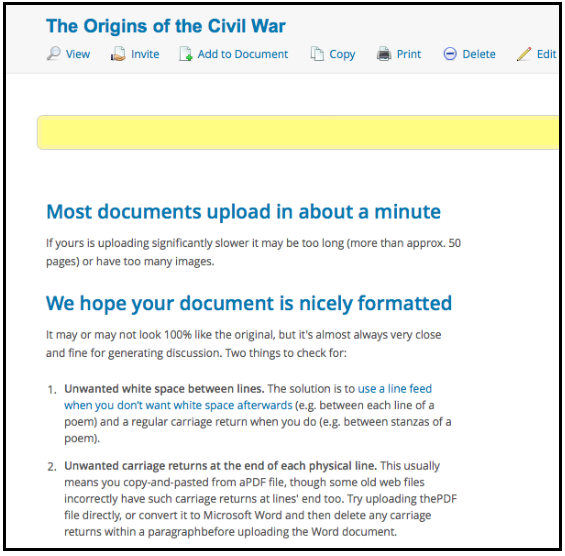
A yellow message area at the top of the next page will show you the status of the upload, eventually ending with a message “Your document is ready; view it now!”:

Your document is now online; click the “view it now” text link to go your document and start commenting on it, and/or share it with others.
This isn't necessarily part of uploading a document, but it lets you upload a document just once even if you want multiple groups/classes to comment on it separately from each other.
From your My Library page (Options menu) or from the “More” dropdown menu when reading the document, choose “Copy”. You'll then have two options (on two tabs):
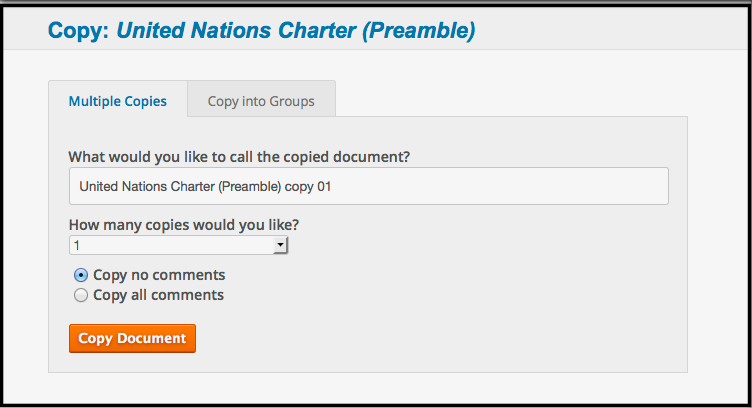
If you aren't using Groups, specify how many copies you want, what suffix should be appended to each document so you can distinguish the various copies form one another (default is copy 1, copy 2), and whether existing comments on the original should or shouldn't be carried over to each copy (teachers might want to “prime the pump ” by inserting some notes or questions as comments).
The image below looks like the one above, but the 2nd (rightmost) tab is shown here.
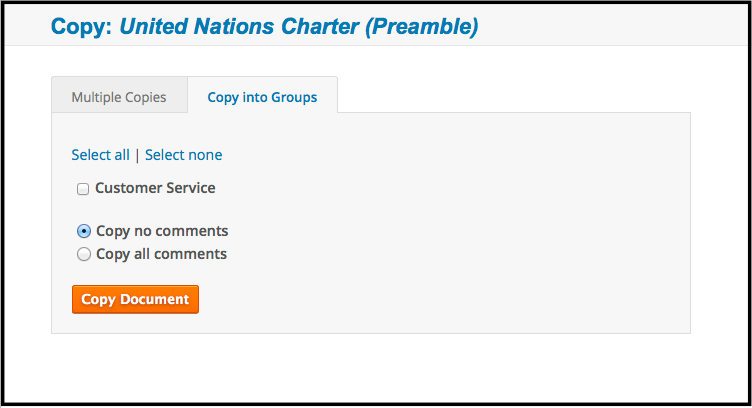
This feature pulls up a checkbox list of all the Groups you're an Admin for (in the screenshot example above there's just the Customer Service group) and lets you share a copy the document with each Group you click on (or click the “Select all” link for all) and automatically invite each selected Group to the document… all in a single step! The Group name is automatically used as a suffix at the end of the document name so you can distinguish the copies from one another.
That's all you need to know about uploading documents. It's very easy and only takes about a minute; try uploading a test document now!
We have other videos and tip files to help you get the most out of Writing Partners … and do take a look at our “Features Gallery” overview.
[Last updated: January 22, 2026]
 on the uploaded document.