Please wait...


Collection: Digital Discourse for What? Return to Group
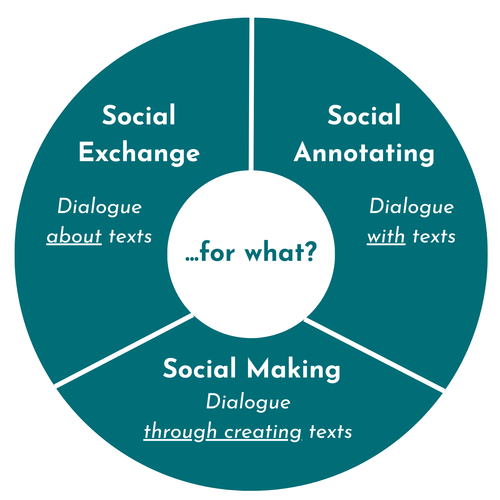 The Writing Partners platform is designed around The Digital Discourse Framework which involves three practices for humanities classrooms: social exchange, social annotating, and social making. As practices, social exchange, annotating, and making orient us to what people are doing with texts: not as plug-and-play activities but as deeper ways of cultivating and conceptualizing the engagement with texts that we want to foster in the humanities classroom. The word social at the beginning of each one highlights that they are always being practiced with others, whether or not those other people or texts are visible. The question ‘digital discourse for what?’ is at the center to remind us that these digital discourse practices should always be in service of deeper purposes that drive teaching and learning. Building on this framework, educators in the The Digital Discourse Project have created educational and curricular resources for other humanities teachers.
Please see a full library of resources in the National Writing Project’s Write Now Teacher’s Studio.
Welcome! We invite you to discuss the documents in this collection and to add new documents.
How to add a document to this collection:
- Click here and join this group: Collections: Quality Education.
- Create a documtent by uploading a video, images, or text to Writing Partners. (Click here to see how to upload on Writing Partners.)
- Add that document to this collection by finding it in the dropdown menu.
-
1 Comment
The Digital Discourse Framework: Social Exchange


Social exchange is dialogue about texts, usually through back-and-forth comments, posts, or threaded discussions. The focus is on collaborative sense-making and the exchange of ideas as students talk about texts using multimodal communication channels.
-
1 Comment
The Digital Discourse Framework: Social Annotating

Social annotating is dialogue with texts, as students and teachers leave responses on a text that others can see and respond to, resulting in a layering of texts on texts on texts that builds from the original. Social annotating helps to make thinking visible and anchor discussion in the text.
-
1 Comment
The Digital Discourse Framework: Social Making

Social making is dialogue through texts – the practice of creating a new text in response to or inspired by the original (e.g., art, poetry, fiction, essays, music, podcasts, playlists). Social making highlights students’ own sensemaking as readers/writers and invites personal engagement with texts and ideas.
 on the uploaded document.